Brit Care Dog Food Review: Salmon Recipe, Score and Value
Brit Care Dog Grain-free Adult salmon earns B, 84/100, in the current PetFoodRate product record. Whether it belongs on your shopping list depends on the exact recipe, your dog's needs and the offer you can actually receive. A brand name or a percentage on the front of a bag cannot settle all three.
This is a source-based editorial review of the adult salmon dry food for small and medium-breed dogs. We checked the manufacturer's current and historical declarations and the live PetFoodRate record on 10 September 2026. We have not fed this food to a trial group, commissioned laboratory tests or measured changes in dogs' health. No veterinarian has been attributed a clinical review of this article.
Contents
- Which Brit Care food does this review cover?
- The current recipe at a glance
- Why older salmon reviews can disagree
- What the B score actually tells you
- What ingredient claims leave unanswered
- Grain-free and suitability for your dog
- Questions worth sending to the manufacturer
- How to compare a real offer
- Choosing between a small and large bag
- Your first-order decision checklist
- Frequently asked questions
Which Brit Care food does this review cover?
The reviewed name is Brit Care Dog Grain-free Adult. “Brit”, “Brit Care” and “salmon” are not sufficient identifiers on their own. A search result may show a different life stage, a different dog size, an older formulation or cat food. Keep the complete product name alongside any score you save.
This article does not review the Puppy, Junior, Senior, Large Breed or cat recipes. It also does not establish that all foods from the brand have similar ingredients, nutritional characteristics or value. If you arrived looking for a Brit Care cat food review, use our product catalogue to locate the exact cat product; this dog's grade cannot answer that question.
A useful shortlist entry therefore has several fields: species, life stage, recipe name, food format, bag weight and country of sale. You can record them in a note before comparing shops. If a seller omits one of those fields, request clarification instead of filling the gap from a different listing.
The Brit brand page helps you navigate the products in our catalogue. Its brand-level information serves a different purpose from this review. The individual salmon product record is the appropriate reference for this recipe's declared composition and current score.
For an English-speaking shopper buying outside France, the page language does not make a French retailer offer local. Check the delivery country and currency separately. A useful review should help you identify the food even when the merchant available to you is different.
The current recipe at a glance
The manufacturer's current declaration lists salmon at 50%, combining dried and hydrolysed forms, potatoes at 26%, and salmon oil at 3%. Chicken fat and pea flour are also present. The split between the two salmon forms is not disclosed on that page. Listed bag sizes are 1, 3 and 12 kg.
| Declared analytical constituent | Current value |
|---|---|
| Crude protein | 26% |
| Fat | 15% |
| Crude ash | 6.2% |
| Crude fibre | 3.5% |
| Moisture | 10% |
| Calcium | 1.1% |
| Phosphorus | 0.8% |
These are manufacturer-declared values, not our laboratory results. They describe this reference, not every batch or regional listing bearing a similar name. The full ingredients and additives are available in the source; reproducing a long additive list would not establish what the food achieves in an individual dog.
Read percentages according to their heading. An ingredient percentage and an analytical protein percentage answer different questions. Neither should be relabelled as a percentage of “usable meat” or converted into an assumed digestibility result. We have not measured that result.
For a general explanation of the distinction between composition and analytical constituents, see FEDIAF's consumer label guide. FEDIAF is an industry federation; its label guidance is useful for terminology, while the recipe declaration comes from the manufacturer.
When you receive a bag, compare its label with the product you intended to order. A mismatch is a reason to resolve the reference with the seller or manufacturer, not evidence by itself that the bag is counterfeit or unsafe.
Why older salmon reviews can disagree
Brit's historical Salmon and Potato page explicitly points to Dog Grain-free Adult as its direct successor. That older declaration lists different ingredient proportions and some different analytical values. A successor relationship does not mean that every detail stayed the same.
This matters when an old review is attached to a current merchant listing. The reviewer may have purchased a different formulation or format. Equally, a retailer may retain an older title while displaying newer packaging. Neither situation can be resolved confidently from a thumbnail alone.
For a practical check, compare three things side by side: the full manufacturer reference, the seller's composition text and a readable picture of the actual bag label. If these disagree, ask which declaration applies to stock being dispatched. Save the answer with the order rather than relying on memory the next time you buy.
Consider a hypothetical listing with the current product name but an older ingredient table. You do not need to decide which website is “right” in the abstract. You need to know what will arrive. A seller who can identify the actual stock and provide a matching label gives you a more useful answer than an unexplained reassurance that the packaging has changed.
PetFoodRate corrected unconfirmed figures for this recipe on 8 September 2026. Those previous figures matched neither of the manufacturer pages checked in that correction, so we do not describe them as a verified historical formulation. The present update preserves that correction and expands the purchase guidance. It does not restore the old price claims or invent a dated sequence of recipe changes.
What the B score actually tells you
The live product record displays 84/100, grade B. Under our published methodology, the A threshold starts at 85. The current component grades are A for proteins, B for nutrition, A for undesirables, B for transparency and B for species adaptability.
These are outputs of PetFoodRate's scoring rules applied to recorded information. They are not a veterinary certification, a feeding-trial outcome or a percentage probability that your dog will do well. “84” should not be read as “84% healthy”, and the gap to 85 does not establish a meaningful clinical difference between two diets.
Use the score as a navigation aid. Open the underlying record, check that it represents the bag you are considering and read the limitations. Where an important question is unanswered, a high letter cannot supply the missing evidence. A lower letter is also not, by itself, a diagnosis of harm.
The same caution applies to comparisons. A product score and a brand average are not interchangeable. A brand can have different foods for different animals and purposes, and an average may include a changing selection of catalogue entries. Write down the exact recipe names when comparing individual records.
Our rankings can help you locate alternatives to inspect, but this review does not claim that buying the highest numerical score is the correct clinical decision. A food recommended for a specific medical need needs to be assessed in that context with the veterinary team.
For this purchase, the actionable question is whether the available information is sufficient for your decision. If the grade attracts you but the delivered recipe is unclear, clarify the recipe first. If the recipe is clear but suitability is uncertain, resolve suitability before treating the score as a reason to order.
What ingredient claims leave unanswered
A salmon-led name is useful for finding a reference, but it does not mean that the entire recipe is fish-only or free of every poultry-derived ingredient. This matters particularly when someone is trying to avoid an ingredient on veterinary advice. Read the complete declaration and ask for clarification where necessary.
Likewise, seeing “hydrolysed” within an ingredient list does not establish that the finished food is appropriate for an elimination diet. That is a different question from whether a particular ingredient has been processed. This review does not classify the product as a therapeutic allergy diet or provide a home allergy-testing protocol.
A listed ingredient is evidence of its declared presence. It is not, on its own, evidence of a specific outcome such as fewer digestive problems, better mobility or a measurable improvement in coat condition. To assess an outcome claim, you would need evidence relevant to the finished food and the animals being discussed.
That distinction also helps you read owner reviews. “My dog liked it” can describe one owner's experience, but it does not tell you whether your dog will accept it. A report of improvement cannot separate the food from other changes in care. We do not turn merchant reviews into a success rate, and we have not verified the medical histories behind them.
There is still useful shopping information to look for in reviews: whether the full reference is identifiable, whether a delivery problem was resolved and whether the writer discusses the same format. Keep those observations separate from health evidence. Ten comments about shipping do not make a nutritional claim stronger, and one enthusiastic comment is not a controlled comparison.
Grain-free and suitability for your dog
The grain-free label does not settle whether this is the right food for your dog. It describes a formulation feature, not an individual medical assessment. If you are considering the food because of symptoms, a diagnosed condition or a prescribed diet, bring the exact label to your veterinarian before making that decision.
The FDA's questions and answers on non-hereditary dilated cardiomyopathy describe a complex investigation involving multiple possible factors. They do not establish that every grain-free food causes DCM or that the presence of one named ingredient proves a diet safe or unsafe. We cannot derive a Brit-specific risk estimate from that investigation.
Avoid two shopping shortcuts: choosing this recipe solely because grains are absent, or assuming that a web review can rule out dietary risk for an individual dog. Neither conclusion follows from the information checked here. If your veterinary team has recommended a particular diet, an online grade is not a substitute for discussing a proposed change.
Life stage also belongs in the decision. An adult-food review is not an assessment of puppy nutrition. Similarly, a review covering small and medium-breed adult dogs does not establish suitability for every large dog or for reproduction. Match the intended animal and feeding purpose before comparing minor differences between ingredient lists.
The distinction between complete and complementary food matters too. FEDIAF's label guide explains that complete food is intended to provide the required daily nutrients when fed as instructed, whereas complementary food has a different role. Check the actual pack statement for your market rather than assuming that every product carrying the Brit name can serve as the same daily diet.
Questions worth sending to the manufacturer
The WSAVA selection guidelines recommend looking beyond promotional wording. Relevant areas include who formulates the food, their qualifications, quality-control procedures, nutritional adequacy and research. These are questions to investigate, not a certificate that this review awards to Brit.
For this particular recipe, a concise message is more useful than “Is your food good?” Include the complete name, country of purchase and a clear label photo if you already have the bag. Then ask the questions you actually need answered:
- Does this label correspond to your current Dog Grain-free Adult reference in my country?
- Where can I find the applicable complete-food and life-stage statement?
- Who is responsible for formulating this reference, and what relevant qualifications do they hold?
- What finished-product checks support the declared nutritional information?
- Is there published research specific to this food, and can you provide the reference?
- If my veterinarian needs more detailed nutrient information, how can it be obtained?
These are proposed enquiries, not a transcript of a conversation we conducted. We have not received a manufacturer response to this checklist or audited a factory. An unanswered item remains unknown in this review; it should not silently become either a positive certification or an accusation.
Keep the response specific to the recipe. A company brochure discussing research in general may not answer whether this exact formula has been studied. Conversely, a reply referring you to a qualified contact may be useful even if it is not an attractive marketing statement. Preserve the response date so you can revisit it if the formula changes.
How to compare a real offer
Start with offers for the same product and format. A low displayed price for a smaller bag, a bundle or a different life stage is not a direct comparison. At checkout, record the total payable, including delivery and any conditions on the discount.
Illustrative arithmetic only: suppose Shop A offers a 12 kg bag for £60 with £5 delivery, while Shop B offers the identical bag for £64 with delivery included. The delivered totals are £65 and £64. That is about £5.42/kg and £5.33/kg respectively. Shop B is cheaper for that order even though its displayed bag price is higher. These are invented examples, not observed Brit prices or current merchant offers.
A subscription needs its own comparison. Note the first-order price, the renewal price, delivery frequency and cancellation terms. A welcome discount can be real without representing the price of your next order. If you are still establishing whether the reference is suitable, consider whether an automatic repeat order would arrive before you can make that decision.
Retailer offers displayed on PetFoodRate identify their market and may use affiliate links. Check the retailer's final terms before buying. The page's English language does not guarantee UK delivery, and a euro price should not be presented as a pound price. We have not established a current cheapest UK stockist for this food.
The earlier fixed €5.20/kg claim and comparisons implying savings against Royal Canin were removed because they were not established by the verification. This article does not reinstate them. To inspect the available reference, open the product analysis and retailer offers and verify the pack, country and total yourself.
Choosing between a small and large bag
A larger pack may offer a lower price per kilogram, but a useful purchase also has to fit your storage space, ordering budget and rate of use. Paying less per kilogram does not save money on food you cannot use appropriately.
You can estimate pack duration without pretending to prescribe a ration. Illustrative calculation only: if an established feeding plan uses 200 g of this dry food per day, a 3 kg bag contains 15 days and a 12 kg bag contains 60 days. The calculation is bag weight in grams divided by daily grams. It does not recommend 200 g for your dog or establish an opened-bag shelf life.
If your dog also receives wet food or another source of food, do not assume that an unrelated dry-only example represents your actual use. Use the amount in the feeding plan agreed for your dog and update the calculation when that plan changes. The pack-duration result is a purchasing estimate, not a nutritional assessment.
Before ordering the largest format, read the storage instructions and consider where the opened bag will go. The FDA's storage guidance recommends retaining the original packaging, keeping dry food cool and dry, and preserving identifying information. Placing the original bag inside a suitable container also keeps the label available.
We have not confirmed a universal number of weeks for keeping this recipe after opening. Ask the manufacturer if the bag does not answer your storage question. A smaller first purchase can be a reasonable logistical choice when the exact reference is unfamiliar, without implying that a short feeding period proves long-term suitability.
Your first-order decision checklist
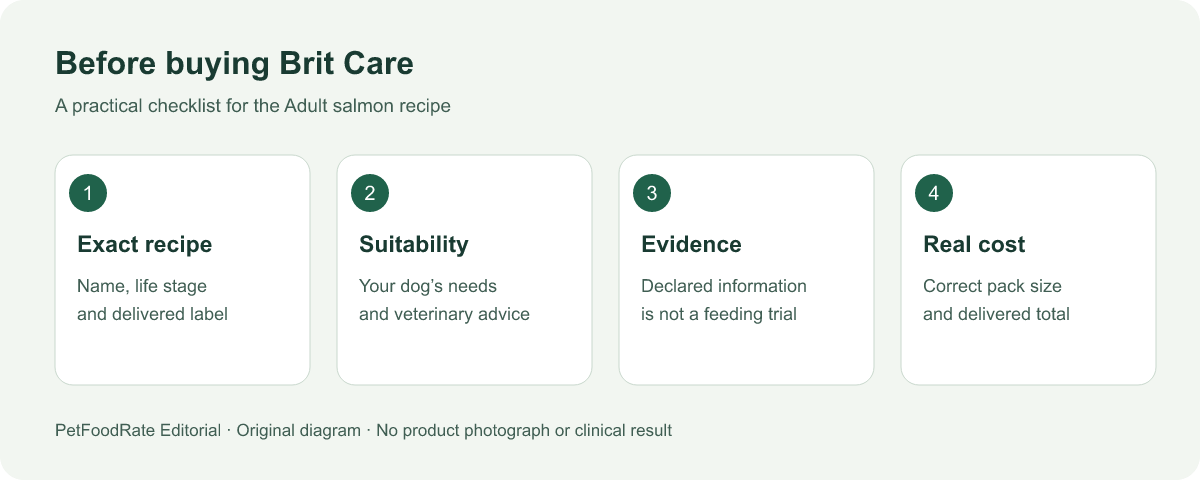
Before paying, work through the following checks. Each should lead to a concrete answer or a clearly identified question rather than a collection of reassuring labels.
| Check | What you should be able to identify |
|---|---|
| Recipe | Full name, species, life stage and current composition |
| Suitability | Any dietary restriction or veterinary question still unresolved |
| Evidence | What comes from the manufacturer, the score and individual comments |
| Offer | Correct pack, delivery country, total cost and repeat-order terms |
| Arrival | Matching label, intact packaging and readable identifying details |
If the recipe is unclear, contact the seller before ordering. If suitability is unclear, ask your veterinary team with the label in front of you. If the total is unclear, reach the final checkout summary before comparing prices. Each question has a different source of information; a higher score cannot answer all of them.
When the bag arrives, keep the order details and check what was delivered. Record the opening date somewhere convenient. If there is a problem, the full product name and batch information are more useful than a screenshot of an old search result. This is routine purchase documentation, not a claim that a particular batch has been recalled.
For a straightforward shortlist decision, this recipe has a published declaration and a specific PetFoodRate record you can inspect. Its value for your household remains conditional on suitability, the actual reference delivered and the price available in your market. That is enough to support a careful comparison without promising improved health, universal acceptance or future savings.
Frequently asked questions
Is Brit Care dog food good?
That question needs an exact recipe and an individual dog's context. This review covers Dog Grain-free Adult salmon, whose current PetFoodRate score is B, 84/100. The score summarises our recorded information under our methodology. It does not establish that every Brit product is equivalent or that this food is suitable for a dog with a particular medical need.
Is this the same as Brit Care Salmon and Potato?
The historical manufacturer page identifies Dog Grain-free Adult as a direct successor. That does not make the declarations identical. Compare the full product name and the actual pack label with the current manufacturer information. If a shop mixes old and new descriptions, ask which stock it will dispatch before ordering.
Is Brit Care salmon chicken-free?
The current declaration includes chicken fat, so it should not be described as free of all chicken-derived ingredients. If you are avoiding chicken on veterinary advice, show the complete recipe to your veterinary team and seek manufacturer clarification where needed. This review cannot certify it for an elimination diet.
Does the review also cover Brit Care cat food?
No. The adult dog recipe, its analytical values and its score cannot be transferred to a cat product. Identify the exact Brit Care cat reference and assess its own declaration, feeding purpose and life stage. A shared brand name does not make two foods interchangeable.
Is Brit Care grain-free food safe for every dog?
No web review can establish suitability for every dog. The FDA's investigation into non-hereditary DCM does not provide a simple verdict on this particular recipe. Discuss the exact food with your veterinarian if your dog has a condition, dietary restriction or an existing prescribed feeding plan.
How much does Brit Care cost per day?
Use the price you actually pay and the quantity in your dog's appropriate feeding plan. Delivered price per kilogram multiplied by daily kilograms gives a dry-food purchasing estimate. This article does not confirm a universal ration or current market price, so it does not publish a single daily-cost promise.
Have you tested this food on dogs?
No. This is a review of published manufacturer information and the PetFoodRate product record, with practical purchasing guidance. We have not carried out a feeding trial, laboratory analysis or clinical assessment. Owner experiences, retailer availability and manufacturer claims are not presented as experiments performed by our editorial team.
